
Live Online Masterclass · Registration Open
AI-Powered Internal Audit
Learn how to use Generative AI across audit planning, risk assessment, control analysis, fieldwork, findings and reporting while maintaining professional judgment, confidentiality and appropriate human oversight.
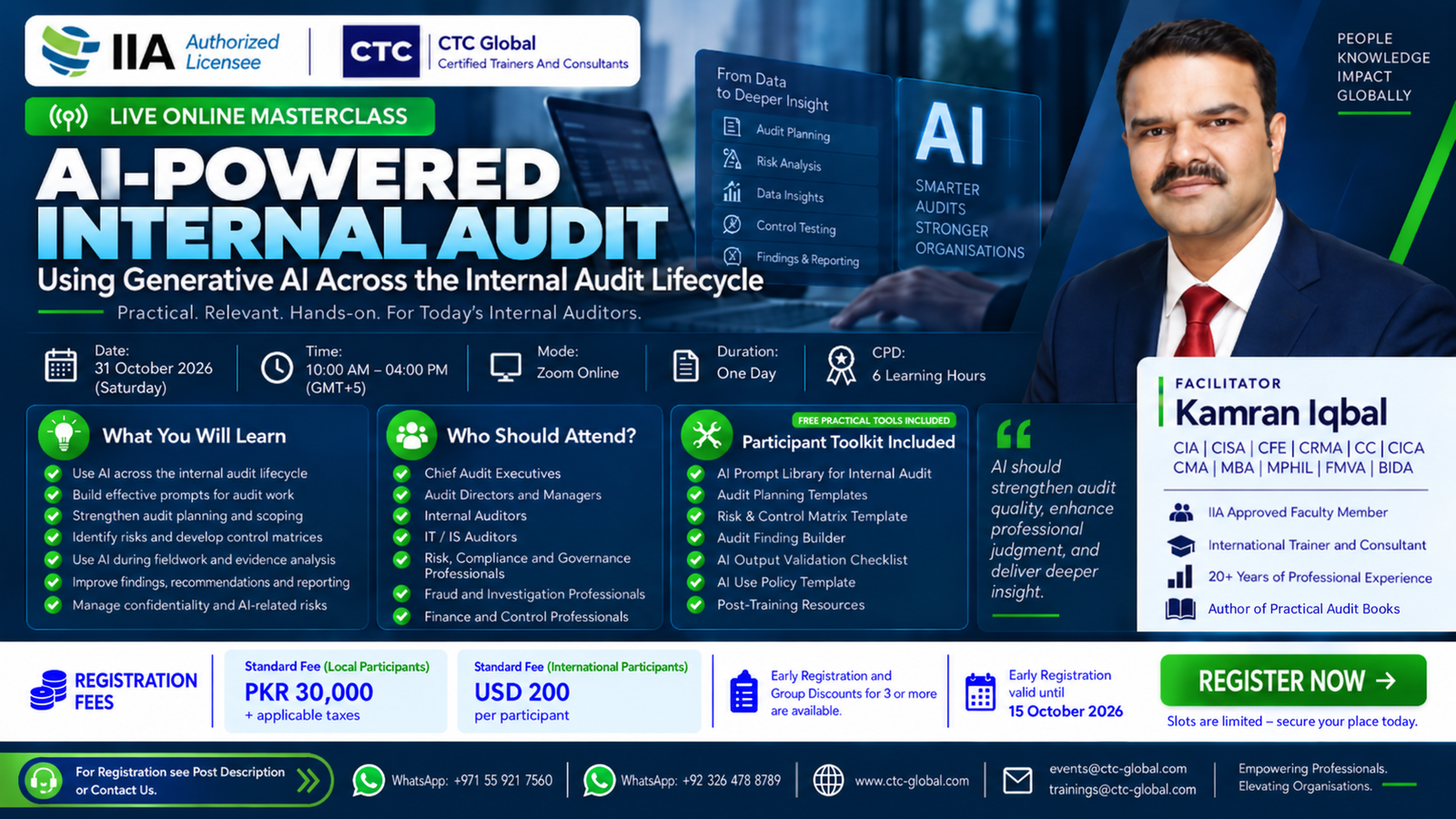
Date31 Oct 2026
Time10:00 AM PKT
DeliveryOnline
CPD6.0 Hours
LanguageEnglish
Using Generative AI Across the Internal Audit Lifecycle
Artificial Intelligence is rapidly changing how professionals research, analyze information, communicate and make decisions.
Internal audit is no exception.
However, using AI effectively in internal audit requires far more than entering a few prompts into an AI platform.
Auditors need to understand:
- where AI can genuinely improve audit work;
- where AI introduces additional risk;
- how to structure effective prompts;
- how to critically evaluate AI-generated output;
- how to protect confidential information;
- how to maintain professional skepticism; and
- how to ensure that accountability remains with the auditor.
AI-Powered Internal Audit is a practical one-day masterclass designed specifically for internal audit and assurance professionals.
Participants will learn how Generative AI can support activities across the entire internal audit lifecycle, from planning an engagement to communicating final results.
The session combines practical demonstrations, audit scenarios, structured exercises and ready-to-use professional tools.
This is not a theory-only AI webinar.
The focus is on applying AI to real internal audit work.
Internal audit is no exception.
However, using AI effectively in internal audit requires far more than entering a few prompts into an AI platform.
Auditors need to understand:
- where AI can genuinely improve audit work;
- where AI introduces additional risk;
- how to structure effective prompts;
- how to critically evaluate AI-generated output;
- how to protect confidential information;
- how to maintain professional skepticism; and
- how to ensure that accountability remains with the auditor.
AI-Powered Internal Audit is a practical one-day masterclass designed specifically for internal audit and assurance professionals.
Participants will learn how Generative AI can support activities across the entire internal audit lifecycle, from planning an engagement to communicating final results.
The session combines practical demonstrations, audit scenarios, structured exercises and ready-to-use professional tools.
This is not a theory-only AI webinar.
The focus is on applying AI to real internal audit work.
Who Should Attend
This program is suitable for:
- Chief Audit Executives
- Heads of Internal Audit
- Audit Directors
- Internal Audit Managers
- Senior Internal Auditors
- Internal Auditors
- IT Auditors
- IS Auditors
- Risk Professionals
- Compliance Professionals
- Governance Professionals
- Fraud and Investigation Professionals
- Finance Professionals
- Internal Control Professionals
No programming or coding experience is required.
- Chief Audit Executives
- Heads of Internal Audit
- Audit Directors
- Internal Audit Managers
- Senior Internal Auditors
- Internal Auditors
- IT Auditors
- IS Auditors
- Risk Professionals
- Compliance Professionals
- Governance Professionals
- Fraud and Investigation Professionals
- Finance Professionals
- Internal Control Professionals
No programming or coding experience is required.
Learning Outcomes
By the end of the masterclass, participants should be able to:
- use Generative AI more effectively across the internal audit lifecycle;
- develop stronger and more structured prompts for audit assignments;
- use AI to support audit planning and scoping;
- identify and articulate risks more effectively;
- develop Risk and Control Matrices with AI support;
- design audit procedures and testing approaches;
- prepare more focused audit interview questions;
- use AI to assist with evidence review and analysis;
- challenge AI-generated assumptions and conclusions;
- improve root cause analysis;
- develop clearer audit findings;
- improve risk and consequence statements;
- develop more practical recommendations;
- improve audit reports and executive summaries;
- manage confidentiality and AI-related risks;
- establish appropriate controls over the use of AI within internal audit; and
- develop an implementation roadmap for an AI-enabled internal audit function.
- use Generative AI more effectively across the internal audit lifecycle;
- develop stronger and more structured prompts for audit assignments;
- use AI to support audit planning and scoping;
- identify and articulate risks more effectively;
- develop Risk and Control Matrices with AI support;
- design audit procedures and testing approaches;
- prepare more focused audit interview questions;
- use AI to assist with evidence review and analysis;
- challenge AI-generated assumptions and conclusions;
- improve root cause analysis;
- develop clearer audit findings;
- improve risk and consequence statements;
- develop more practical recommendations;
- improve audit reports and executive summaries;
- manage confidentiality and AI-related risks;
- establish appropriate controls over the use of AI within internal audit; and
- develop an implementation roadmap for an AI-enabled internal audit function.
Program Agenda
Module 1 — Generative AI for Internal Auditors
Understanding AI from an Auditor's Perspective
- What Generative AI is
- Large Language Models explained simply
- Generative AI versus traditional automation
- Where AI can support internal audit
- What AI still does poorly
- Why convincing AI output may still be incorrect
- Understanding hallucinations
- Bias and incomplete information
- Maintaining professional skepticism
Responsible AI Use
- Confidentiality
- Sensitive audit information
- Personal data
- Proprietary information
- Validation requirements
- Human oversight
- Professional accountability
Practical Activity
Participants review an AI-generated audit response and identify:
- unsupported assumptions;
- missing information;
- potential errors; and
- areas requiring professional validation.
Module 2 — Prompt Engineering for Audit Professionals
The quality of AI output is heavily influenced by the quality of the instructions given to it.
Participants will learn how to structure professional prompts using:
- role;
- objective;
- context;
- background information;
- source information;
- constraints;
- expected output;
- evaluation criteria; and
- validation instructions.
Practical Applications
- improving weak prompts;
- iterative prompting;
- challenging AI output;
- requesting alternative explanations;
- testing assumptions;
- using AI as a reviewer rather than simply a writer.
Practical Exercise
Participants transform poorly structured prompts into professional audit prompts.
Module 3 — AI-Assisted Audit Planning
Participants will learn how AI can support:
- understanding the process under review;
- preliminary research;
- identifying process objectives;
- identifying potential risks;
- determining audit objectives;
- defining scope;
- developing preliminary information requirements;
- preparing stakeholder interview questions;
- identifying emerging risks; and
- preparing an audit planning memorandum.
Practical Case
Participants work through a simulated business process and develop:
Process Understanding → Risks → Audit Objectives → Scope → Information Requirements
Module 4 — Risk & Control Assessment with AI
Participants will explore how Generative AI can support the development and review of Risk and Control Matrices.
Topics include:
- identifying risks;
- improving risk statements;
- identifying potential controls;
- identifying control gaps;
- distinguishing preventive and detective controls;
- assessing control design;
- identifying key controls;
- developing audit procedures; and
- challenging an existing RCM.
Practical Exercise
Participants develop and critically review a Risk and Control Matrix using a provided scenario.
The exercise will also demonstrate why AI-generated controls and risks must not be accepted without professional review.
Module 5 — AI During Audit Fieldwork
Participants will explore practical applications of AI during fieldwork, including:
- preparing audit interviews;
- developing follow-up questions;
- summarizing information;
- reviewing procedures;
- comparing documents;
- identifying inconsistencies;
- developing testing approaches;
- organizing audit evidence;
- analyzing exceptions; and
- documenting audit work.
Practical Exercise
Participants review simulated audit evidence and identify:
- potential control failures;
- missing evidence;
- contradictions;
- additional questions; and
- further procedures required.
Module 6 — Findings, Root Cause & Recommendations
Strong findings require more than good writing.
Participants will explore how AI can support the development of:
- condition;
- criteria;
- cause;
- consequence;
- risk;
- recommendation; and
- management action.
Root Cause Analysis
Practical AI-assisted approaches will include:
- Five Whys;
- causal questioning;
- process breakdown analysis;
- people, process and technology analysis;
- distinguishing symptoms from causes.
Practical Exercise
Participants receive a weak audit observation and transform it into a stronger, evidence-based finding.
Module 7 — AI-Assisted Audit Reporting
Participants will learn how AI can assist in improving:
- audit findings;
- risk statements;
- recommendations;
- report structure;
- clarity;
- conciseness;
- tone;
- executive summaries;
- management communication; and
- Audit Committee communication.
Practical Exercise
Participants convert the same audit issue into four different forms:
1. Working-paper observation
2. Management-level finding
3. Executive summary
4. Audit Committee communication
This demonstrates how the same issue must be communicated differently depending on the audience.
Module 8 — Building an AI-Enabled Internal Audit Function
The final part of the session moves beyond individual productivity.
Participants will explore:
- identifying appropriate AI use cases;
- defining prohibited AI uses;
- approved AI platforms;
- confidentiality requirements;
- human review requirements;
- accountability;
- developing an internal audit prompt library;
- quality assurance;
- documentation expectations;
- training internal auditors;
- monitoring AI usage;
- AI governance; and
- developing an implementation roadmap.
Understanding AI from an Auditor's Perspective
- What Generative AI is
- Large Language Models explained simply
- Generative AI versus traditional automation
- Where AI can support internal audit
- What AI still does poorly
- Why convincing AI output may still be incorrect
- Understanding hallucinations
- Bias and incomplete information
- Maintaining professional skepticism
Responsible AI Use
- Confidentiality
- Sensitive audit information
- Personal data
- Proprietary information
- Validation requirements
- Human oversight
- Professional accountability
Practical Activity
Participants review an AI-generated audit response and identify:
- unsupported assumptions;
- missing information;
- potential errors; and
- areas requiring professional validation.
Module 2 — Prompt Engineering for Audit Professionals
The quality of AI output is heavily influenced by the quality of the instructions given to it.
Participants will learn how to structure professional prompts using:
- role;
- objective;
- context;
- background information;
- source information;
- constraints;
- expected output;
- evaluation criteria; and
- validation instructions.
Practical Applications
- improving weak prompts;
- iterative prompting;
- challenging AI output;
- requesting alternative explanations;
- testing assumptions;
- using AI as a reviewer rather than simply a writer.
Practical Exercise
Participants transform poorly structured prompts into professional audit prompts.
Module 3 — AI-Assisted Audit Planning
Participants will learn how AI can support:
- understanding the process under review;
- preliminary research;
- identifying process objectives;
- identifying potential risks;
- determining audit objectives;
- defining scope;
- developing preliminary information requirements;
- preparing stakeholder interview questions;
- identifying emerging risks; and
- preparing an audit planning memorandum.
Practical Case
Participants work through a simulated business process and develop:
Process Understanding → Risks → Audit Objectives → Scope → Information Requirements
Module 4 — Risk & Control Assessment with AI
Participants will explore how Generative AI can support the development and review of Risk and Control Matrices.
Topics include:
- identifying risks;
- improving risk statements;
- identifying potential controls;
- identifying control gaps;
- distinguishing preventive and detective controls;
- assessing control design;
- identifying key controls;
- developing audit procedures; and
- challenging an existing RCM.
Practical Exercise
Participants develop and critically review a Risk and Control Matrix using a provided scenario.
The exercise will also demonstrate why AI-generated controls and risks must not be accepted without professional review.
Module 5 — AI During Audit Fieldwork
Participants will explore practical applications of AI during fieldwork, including:
- preparing audit interviews;
- developing follow-up questions;
- summarizing information;
- reviewing procedures;
- comparing documents;
- identifying inconsistencies;
- developing testing approaches;
- organizing audit evidence;
- analyzing exceptions; and
- documenting audit work.
Practical Exercise
Participants review simulated audit evidence and identify:
- potential control failures;
- missing evidence;
- contradictions;
- additional questions; and
- further procedures required.
Module 6 — Findings, Root Cause & Recommendations
Strong findings require more than good writing.
Participants will explore how AI can support the development of:
- condition;
- criteria;
- cause;
- consequence;
- risk;
- recommendation; and
- management action.
Root Cause Analysis
Practical AI-assisted approaches will include:
- Five Whys;
- causal questioning;
- process breakdown analysis;
- people, process and technology analysis;
- distinguishing symptoms from causes.
Practical Exercise
Participants receive a weak audit observation and transform it into a stronger, evidence-based finding.
Module 7 — AI-Assisted Audit Reporting
Participants will learn how AI can assist in improving:
- audit findings;
- risk statements;
- recommendations;
- report structure;
- clarity;
- conciseness;
- tone;
- executive summaries;
- management communication; and
- Audit Committee communication.
Practical Exercise
Participants convert the same audit issue into four different forms:
1. Working-paper observation
2. Management-level finding
3. Executive summary
4. Audit Committee communication
This demonstrates how the same issue must be communicated differently depending on the audience.
Module 8 — Building an AI-Enabled Internal Audit Function
The final part of the session moves beyond individual productivity.
Participants will explore:
- identifying appropriate AI use cases;
- defining prohibited AI uses;
- approved AI platforms;
- confidentiality requirements;
- human review requirements;
- accountability;
- developing an internal audit prompt library;
- quality assurance;
- documentation expectations;
- training internal auditors;
- monitoring AI usage;
- AI governance; and
- developing an implementation roadmap.

Kamran Iqbal
Lead Trainer
CIA, CISA, CFE, CRMA, CC, CMA, MBA, MPhil, LLB, FMVA
Kamran Iqbal is an International Trainer, IIA Approved Faculty Member, and seasoned audit and risk professional with 20+ years of experience across internal audit, IT/IS audit, risk management, governance, internal controls, fraud and data analytics.
For more than a decade, he has delivered professional training programmes to professionals and organizations across diverse sectors, with a strong emphasis on practical application rather than purely theoretical learning.
He is also the author of various professional books, audit checklists and practical tools designed for internal audit, risk and assurance professionals.
For more than a decade, he has delivered professional training programmes to professionals and organizations across diverse sectors, with a strong emphasis on practical application rather than purely theoretical learning.
He is also the author of various professional books, audit checklists and practical tools designed for internal audit, risk and assurance professionals.
Cancellation & Refund Policy
Fee is non-refundable and non-transferable.